SEO Articles & Brand EditorialBendigo Bank
Writing for Bendigo Bank meant making everyday banking, financial complexities and budgeting feel manageable for individuals and families: practical, encouraging blog content in plain language that speaks to the reader where they are without being patronising or talking down.
Brief:
A series of SEO-optimised blog articles for the Bendigo Bank website, aimed at family banking customers and prospective customers. The brief was to explain everyday banking and budgeting concepts in straightforward, friendly language.
More published work:
Excerpt:
The extract below is from the published version as at 17 January 2026.
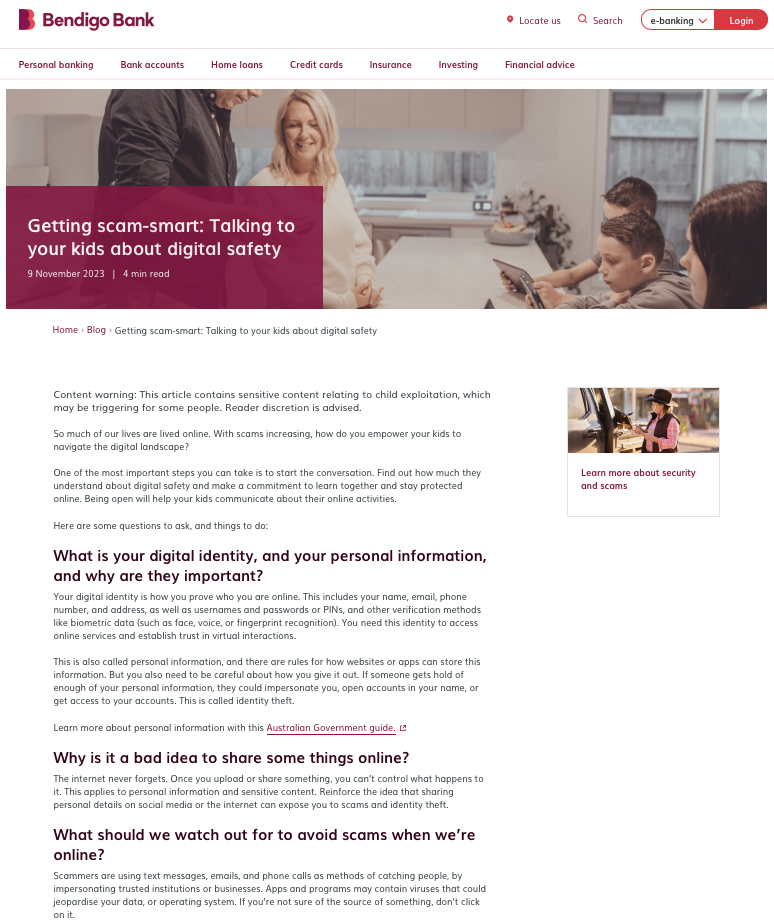
Getting scam-smart: Talking to your kids about digital safety
9 November 2023
Content warning: This article contains sensitive content relating to child exploitation, which may be triggering for some people. Reader discretion is advised.
So much of our lives are lived online. With scams increasing, how do you empower your kids to navigate the digital landscape?
One of the most important steps you can take is to start the conversation. Find out how much they understand about digital safety and make a commitment to learn together and stay protected online. Being open will help your kids communicate about their online activities.
Here are some questions to ask, and things to do:
What is your digital identity, and your personal information, and why are they important?
Your digital identity is how you prove who you are online. This includes your name, email, phone number, and address, as well as usernames and passwords or PINs, and other verification methods like biometric data (such as face, voice, or fingerprint recognition). You need this identity to access online services and establish trust in virtual interactions.
This is also called personal information, and there are rules for how websites or apps can store this information. But you also need to be careful about how you give it out. If someone gets hold of enough of your personal information, they could impersonate you, open accounts in your name, or get access to your accounts. This is called identity theft.
Learn more about personal information with this Australian Government guide.- external site
Why is it a bad idea to share some things online?
The internet never forgets. Once you upload or share something, you can’t control what happens to it. This applies to personal information and sensitive content. Reinforce the idea that sharing personal details on social media or the internet can expose you to scams and identity theft.
…
What can you do to protect yourself from scams?
Put aside some time to work together on this with your kids. Empower them to manage their own safety as well. Here are some key things to do:
Create strong, unique passwords for every online account. You can get a password manager app, which will generate random passwords and call them up as you need them.
Set up two-factor authentication on your online accounts, an extra layer of security beyond your username and password. You can set up an authenticator app to generate codes for different accounts. Check out our device security guide here.
Regularly review the permissions settings for all apps on your phones and tablets, especially data sharing and location permissions.
Keep all your devices’ software updated to ensure the security is up to date, including smart-home devices and home computers.
Most recent operating systems come with sufficient antivirus security, but you might consider antivirus software for shared computers.
Never provide personal information or images to someone you don't know online.
Keep educating yourself – the Australian Government has a comprehensive checklist- external site for online safety.
…